
Chiropractic for Migraines: The C1-C2 Vertebrae Connection


A migraine that starts at the base of your skull is telling you something specific. So is one that only ever hits the left side, or one that comes with neck stiffness before the pain arrives. These aren't just migraine variations — they're patterns that point toward a cervical component, and in many cases, the C1 and C2 vertebrae are directly involved.
This doesn't mean chiropractic is a cure for migraines. It means that for a subset of migraine sufferers, the cervical spine is part of the trigger, and ignoring it means managing symptoms while
leaving the mechanism in place.
What C1 and C2 Do
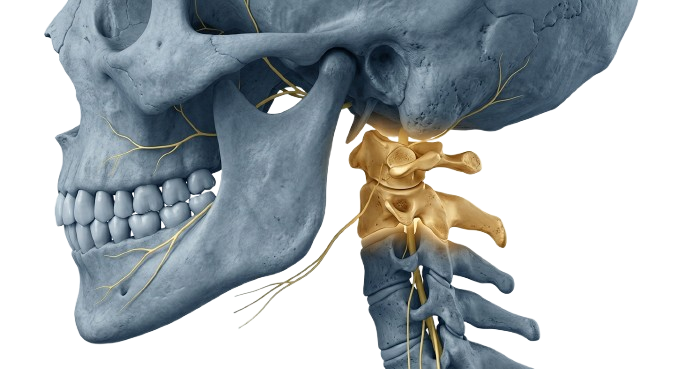
The first and second cervical vertebrae sit at the very top of the spine, right where the skull meets the neck. They're structurally unlike any other vertebrae in the spine. C1 (the atlas) is a ring-shaped bone that supports the skull and allows the nodding motion. C2 (the axis) has a projection C1 rotates around, which is how you turn your head.
Because of their location and the density of neurological structures in that area, C1 and C2 have a disproportionate influence on what happens above them. The trigeminal nucleus — the sensory gateway that processes pain signals from the face, scalp, and meninges — extends down into the upper cervical spinal cord. Irritation or restricted motion at C1/C2 can sensitize this nucleus and lower the threshold for migraine activation.
This is called the trigeminocervical complex. It's why neck manipulation has been studied as a migraine intervention, and why the results are significant enough that some neurologists now refer migraine patients for cervical assessment.
What Cervicogenic Headaches Look Like
Not all migraines have a cervical component, so it's worth knowing the pattern. Headaches with a cervical driver tend to:
Start at the base of the skull or upper neck before spreading
Be consistently one-sided (on the side of the restriction)
Worsen with sustained neck positions like looking at a screen or driving
Come with restricted neck rotation — turning feels stiffer on the headache side
Respond somewhat to neck massage but return quickly
If this matches your pattern, you are not just a "migraine sufferer." You have a structural component that can be addressed.
What Assessment and Treatment Look Like
At Chiropractic Works, assessment for cervicogenic headaches involves examining the upper cervical joints for restriction and tenderness, checking range of motion, and understanding the full headache pattern — when it occurs, how it starts, what relieves it. If imaging is needed, that gets ordered.
Adjustment to C1 and C2 is specific and controlled. This is not the same as general neck manipulation. The upper cervical spine requires a precise, low-force approach, and Dr. Mukeku has the training to do it correctly.
For patients who have been on migraine medication for years without getting ahead of the frequency, a cervical assessment is worth doing. You may be treating the symptom while the structural trigger stays in place.
If your migraines follow a pattern that starts in the neck, call us at 248-398-1650. Our Oak Park clinic accepts BCBS, Aetna, Medicare, Medicaid, and Michigan no-fault auto insurance.
📍 21790 Coolidge Hwy, Oak Park, MI 48237
📞 (248) 398-1650

Comments