
Spinal Decompression vs. Hanging from a Bar: The Truth About Disc Relief


Hi everyone,
We see it all the time—a patient comes in, holding their lower back, and says, “Dr. Duncan, I’ve been hanging from a pull-up bar in my garage every morning to stretch my spine, but my sciatica is still killing me. What gives?”
It’s a great question. On the surface, hanging from a bar and clinical spinal decompression seem like they’re doing the same thing: using gravity to pull the spine apart. But if you look under the hood at how your body actually responds to those two things, they couldn't be more different.
The "Guard Dog" Effect (Why Hanging Often Fails)
Your body is incredibly smart. When you hang from a bar, your brain senses a "threat" to your shoulders and spine. To protect your joints from being pulled out of place, your muscles—especially those deep, stabilizing muscles around your discs—automatically contract.
It’s like a "guard dog" waking up to protect the house. Because your muscles are tensing up to hold you onto that bar, the very discs you’re trying to "decompress" are actually staying compressed. You might get a nice stretch in your lats, but you aren’t reaching the source of the pain.
The Science of the "Vacuum"
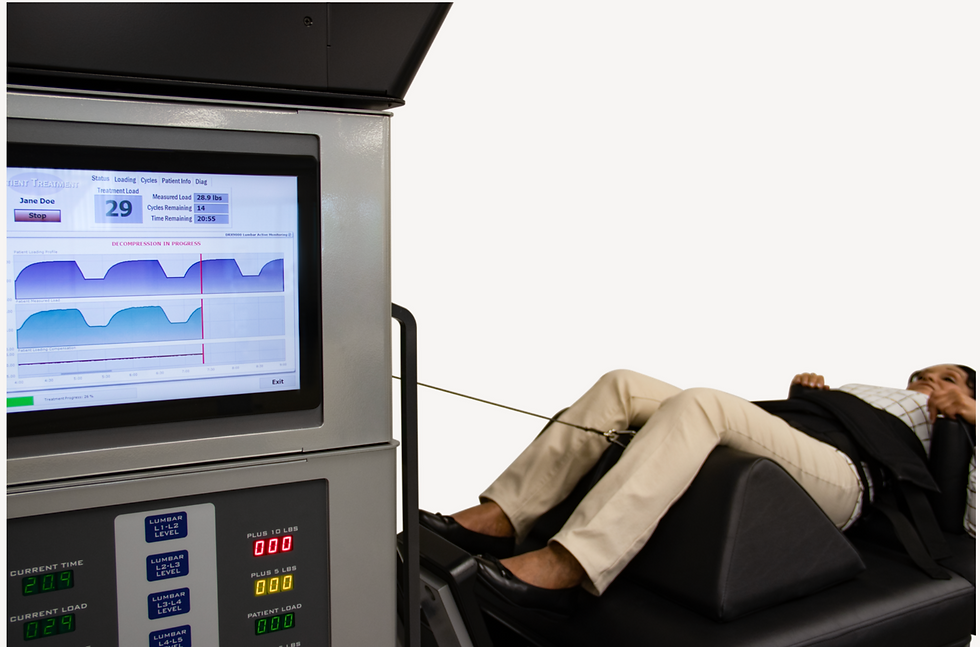
Clinical spinal decompression is a much more sophisticated conversation with your nervous system. Our equipment uses specialized technology to bypass that "guard dog" reflex.
Instead of a constant pull, the system uses a very specific, computer-controlled logarithmic curve. It pulls, then gently relaxes, then pulls again. This "tricks" the muscles into staying relaxed.
When the muscles stay relaxed, we can finally create negative pressure inside the disc. This creates a vacuum effect that:
Rehydrates the disc: Pulling in much-needed nutrients and water.
Retracts the bulge: Gently coaxing that herniated material back toward the center, away from the nerve.
The Bottom Line
Hanging from a bar is a great way to improve your grip strength or stretch your shoulders, but it isn’t a medical treatment for a bulging disc.
If you’ve been "hanging in there" (pun intended!) and still feeling that sharp, shooting pain down your leg, it might be time to stop fighting your muscles and start working with them. Our team is here to help you get to the root of the problem—without the workout.
Stay well,
Dr. Duncan Mukeku D.C., DAAMLP


Comments